
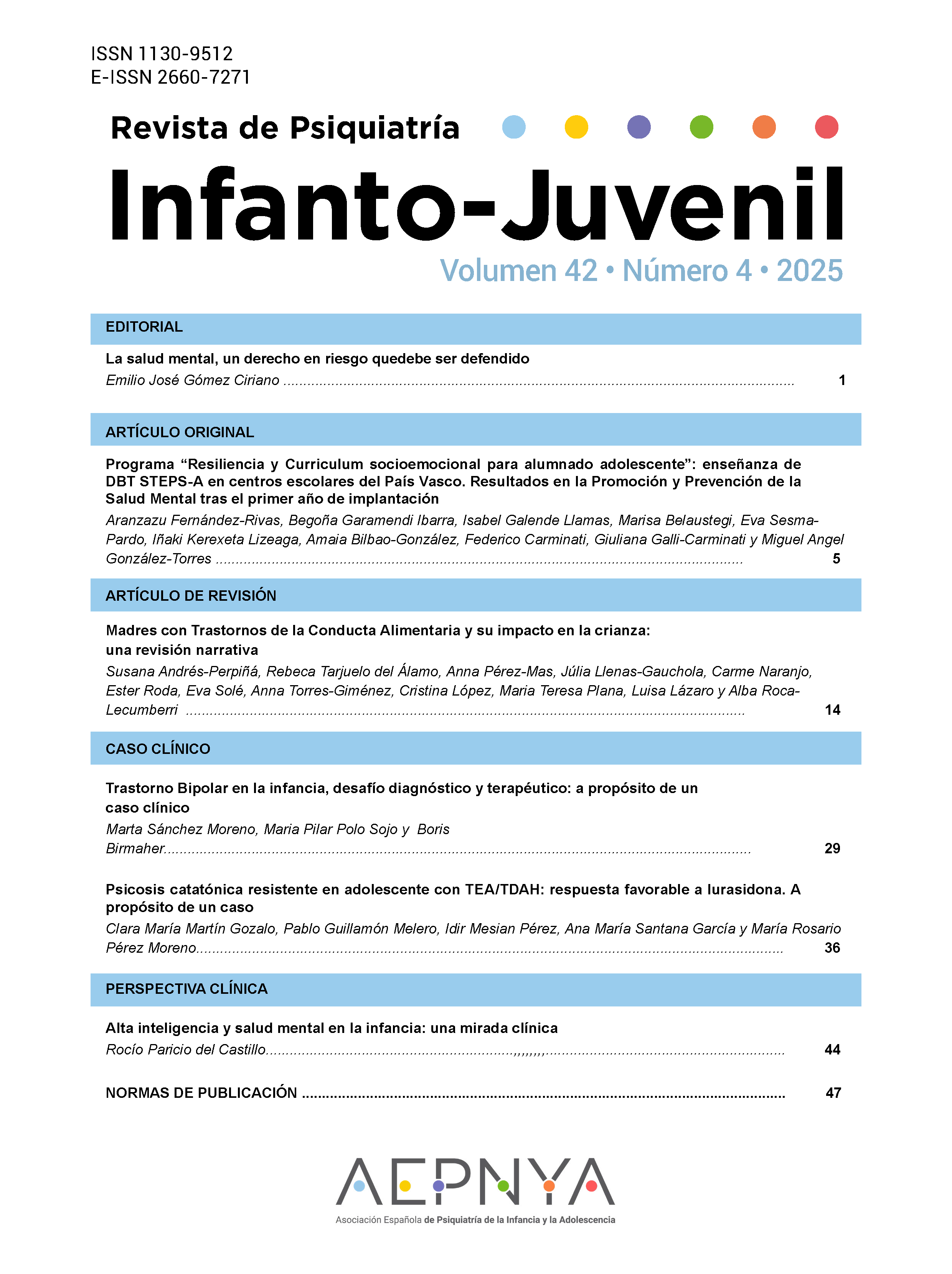
High intelligence and mental health in childhood: a clinical perspective
Published
How to Cite
Issue
Section
License
Copyright (c) 2026 Revista de Psiquiatría Infanto-Juvenil

This work is licensed under a Creative Commons Attribution-NonCommercial-NoDerivatives 4.0 International License.




DOI:
https://doi.org/10.31766/revpsij.v42n4a6Keywords:
intelligence, high abilities, adolescence, mental healthAbstract
High intelligence in childhood and adolescence remains a poorly understood area, fraught with myths, expectations, and inequalities. For decades, its study has been linked almost exclusively to the quantification of cognitive ability. Thus, since the first scales of Binet and Simon, the intelligence quotient (IQ) has served as the central criterion for defining giftedness. This reductionist approach left out essential factors such as creativity, motivation, and the emotional dimension of talent. With the second half of the 20th century came more integrative models, such as Renzulli's, which situated giftedness at the intersection of high intellectual ability, creativity, and task commitment. This approach broadened the conception of high intelligence as a diverse phenomenon, encompassing giftedness, specific talents, and precociousness. However, in Spanish practice, significant heterogeneity persists, as each autonomous community applies its own identification criteria, leading to relevant inequalities and the possibility that the same child may be recognized as gifted in one region but not in another. This regulatory disparity contributes to the fact that many highly intelligent children and adolescents are not identified and, sometimes, do not receive the attention they need.
Downloads
References
Renzulli JS. What makes giftedness? Reexamining a definition. Phi Delta Kappan. 1978;92(8): 81-8. https://doi.org/10.1177/0031721711092008 DOI: https://doi.org/10.1177/003172171109200821
Sanz Chacón C, et al. Informe nacional sobre la educación de los superdotados. Fundación El Mundo del Superdotado; 2024.
Papadopoulos D. Parenting the exceptional social-emotional needs of gifted and talented children: what do we know? Children (Basel). 2021;8(11): 953. https://doi.org/10.3390/children8110953 DOI: https://doi.org/10.3390/children8110953
Renati R, Bonfiglio NS, Dilda M, Mascia ML, Penna MP. Gifted children through the eyes of their parents: talents, social-emotional challenges, and educational strategies from preschool through middle school. Children (Basel). 2023;10: 42. https://doi.org/10.3390/children10010042 DOI: https://doi.org/10.3390/children10010042
Zanetti MA, Sangiuliano Intra F, Taverna L, Brighi A, Marinoni C. The influence of gifted children's stress management on parental stress levels. Children (Basel). 2024;11(5): 538. https://doi.org/10.3390/children11050538 DOI: https://doi.org/10.3390/children11050538
Subotnik RF, Olszewski-Kubilius P, Worrell FC. Rethinking giftedness and gifted education: a proposed direction forward based on psychological science. Psychol Sci Public Interest. 2011;12(1): 3-54. https://doi.org/10.1177/1529100611418056 DOI: https://doi.org/10.1177/1529100611418056
Tasca I, Guidi M, Turriziani P, Mento G, Tarantino V. Behavioral and socio-emotional disorders in intellectual giftedness: a systematic review. Child Psychiatry Hum Dev. 2022. https://doi.org/10.1007/s10578-022-01420-w DOI: https://doi.org/10.1007/s10578-022-01420-w
Duplenne L, Bourdin B, Fernandez DN, Blondelle G, Aubry A. Anxiety and depression in gifted individuals: a systematic and meta-analytic review. Gift Child Q. 2024;68(1): 65-83. https://doi.org/10.1177/00169862231208922 DOI: https://doi.org/10.1177/00169862231208922
D?browski K. Positive disintegration: an outline of the theory of human mental development through mental disequilibrium, nervousness, neuroses and psychoneuroses. London: J & A Churchill; 1964.
Paricio del Castillo R, Palanca Maresca I. Trastorno del espectro autista en menores con superdotación intelectual: descripción de un diagnóstico complejo. Psiquiatr Biol. 2022;29(3): 100377. https://doi.org/10.1016/j.psiq.2022.100377 DOI: https://doi.org/10.1016/j.psiq.2022.100377




 © 2021 AEPNyA Todos los derechos reservados