
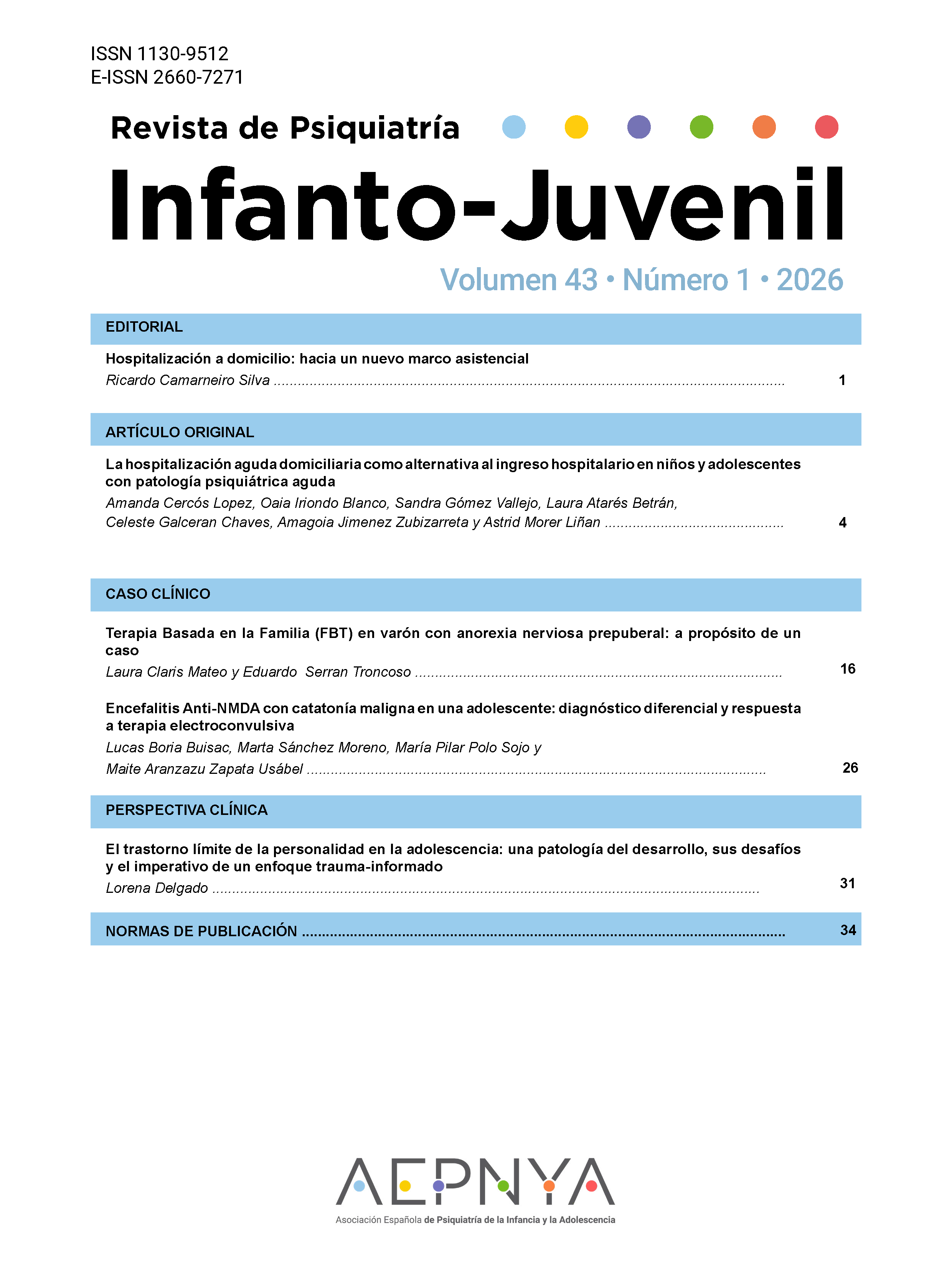
La hospitalización aguda domiciliaria como alternativa al ingreso hospitalario en niños y adolescentes con patología psiquiátrica aguda
Publicado
Cómo citar
Número
Sección
Licencia
Derechos de autor 2026 Revista de Psiquiatría Infanto-Juvenil

Esta obra está bajo una licencia internacional Creative Commons Atribución-NoComercial-SinDerivadas 4.0.




DOI:
https://doi.org/10.31766/revpsij.v43n1a2Palabras clave:
cuidado intensivo, tratamiento domiciliario agudo, patología psiquiátrica aguda, atención hospitalaria, niños y adolescentesResumen
Introducción: Tras la pandemia de COVID-19 se incrementa la patología psiquiátrica en la población infantil y juvenil, con la consiguiente saturación de las urgencias y de las unidades de hospitalización convencionales. En el Hospital Clínic de Barcelona se implementó la Hospitalización Domiciliaria Psiquiátrica Infanto Juvenil (HDOM PIJ), un modelo terapéutico enfocado en el menor en su entorno, minimizando la ruptura ambiental y el carácter restrictivo. HDOM PIJ dispone de tiempos de espera cortos, permitiendo intervenir al inicio de la fase aguda. Métodos: Estudio observacional analítico retrospectivo que evalúa los veintiún primeros meses de funcionamiento d HDOM PIJ (junio 2021 - marzo 2023). Se incluyen los pacientes ingresados en este período. Resultados: Se han incluido 116 pacientes (edad media 14,72 años; 69,8% mujeres). La estancia media fue de 19,67 días y el principal motivo de derivación fue la ideación suicida. Los trastornos depresivos son los diagnósticos más prevalentes, seguidos de los trastornos de la conducta alimentaria, trastornos del neurodesarrollo y trastornos psicóticos. El 37,1% de los pacientes fueron derivados desde hospitalización convencional, seguido de Centro de Salud Mental Infanto Juvenil (CSMIJ) (32,7%) y urgencias (26,7%). Al alta de HDOM PIJ, el 92,2 % fue derivado a un recurso asistencial de menor intensidad terapéutica. Conclusión: La hospitalización domiciliaria supone una alternativa efectiva a la hospitalización convencional. Alivia la saturación hospitalaria y favorece un abordaje integral en el entorno natural del paciente. Ofrece menores tiempos de espera y resultados sostenidos, y equiparables a la hospitalización convencional, y menor uso de recursos al alta.
Descargas
Citas
Boege I, Corpus N, Weichard M, Schepker R, Young P, Fegert JM. Long?term outcome of intensive home treatment for children and adolescents with mental health problems – 4 years after a randomized controlled clinical trial. Child Adolesc Ment Health. 2021;26(4):310-9. https://doi.org/10.1111/camh.12500 DOI: https://doi.org/10.1111/camh.12500
Sacco R, Camilleri N, Eberhardt J, Umla-Runge K, Newbury-Birch D. Systematic review on the prevalence of mental disorders among children and adolescents in Europe. Eur Child Adolesc Psychiatry. 2024;33(12): 2877-94. https://doi.org/10.1007/s00787-022-02131-2 DOI: https://doi.org/10.1007/s00787-022-02131-2
Boege I, Corpus N, Schepker R, Kilian R, Fegert JM. Cost-effectiveness of intensive home treatment enhanced by inpatient treatment elements in child and adolescent psychiatry in Germany: A randomised trial. Eur Psychiatry. 2015;30(5): 583-9. https://doi.org/10.1016/j.eurpsy.2015.01.009 DOI: https://doi.org/10.1016/j.eurpsy.2015.01.009
Garriga M, Agasi I, Fedida E, Pinzón-Espinosa J, Vazquez M, Pacchiarotti I, et al. The role of mental health home hospitalization care during the COVID?19 pandemic. Acta Psychiatr Scand. 2020;141(5): 479-80. https://doi.org/10.1111/acps.13173 DOI: https://doi.org/10.1111/acps.13173
Samji H, Wu J, Ladak A, Vossen C, Stewart E, Dove N, et al. Review: Mental health impacts of the COVID?19 pandemic on children and youth – a systematic review. Child Adolesc Ment Health. 2022;27(2): 173-89. https://doi.org/10.1111/camh.12501 DOI: https://doi.org/10.1111/camh.12501
Marin D, Di Gennaro G, Baracetti M, Zanetti R, Balestrieri M, Cogo P, et al. Confirmation of increased and more severe adolescent mental health-related in-patient admissions in the COVID-19 pandemic aftermath: A 2-year follow-up study. Psychiatry Res Commun. 2023;3(2): 100119. https://doi.org/10.1016/j.psycom.2023.100119 DOI: https://doi.org/10.1016/j.psycom.2023.100119
Foremnik K, Sroczynski G, Stratil J, Neumann A, Buchberger B. Efficacy of home-based and inpatient treatment for children and adolescents in psychiatric crisis: A systematic review protocol. PLoS One. 2025;20(3): e0318792. https://doi.org/10.1371/journal.pone.0318792 DOI: https://doi.org/10.1371/journal.pone.0318792
Organización Mundial de la Salud. Qualityrights. Instrumentos de Calidad y Derechos de la OMS. Evaluando y mejorando la calidad y los derechos humanos en los establecimientos de salud mental y de apoyo social. 2012
Noguero Alegre A, Peregalli Politi S. Alternativas a los internamientos en salud mental: hospitalización domiciliaria desde la perspectiva española y anglosajona. Rev Bioet Derecho. 2021;(53): 37-55. https://doi.org/10.1344/rbd2021.53.34726 DOI: https://doi.org/10.1344/rbd2021.53.34726
Johnson S, Dalton-Locke C, Baker J, Hanlon C, Salisbury TT, Fossey M, et al. Acute psychiatric care: approaches to increasing the range of services and improving access and quality of care. World Psychiatry. 2022;21(2): 220-36. https://doi.org/10.1002/wps.20962 DOI: https://doi.org/10.1002/wps.20962
Ougrin D, Corrigall R, Poole J, Zundel T, Sarhane M, Slater V, et al. Comparison of effectiveness and cost-effectiveness of an intensive community supported discharge service versus treatment as usual for adolescents with psychiatric emergencies: a randomised controlled trial. Lancet Psychiatry. 2018;5(6): 477-85. https://doi.org/10.1016/S2215-0366(18)30129-9 DOI: https://doi.org/10.1016/S2215-0366(18)30129-9
Sjølie H, Karlsson B, Kim HS. Crisis resolution and home treatment: structure, process, and outcome - a literature review: Crisis resolution and home treatment. J Psychiatr Ment Health Nurs. 2010;17(10): 881-92. https://doi.org/10.1111/j.1365-2850.2010.01621.x DOI: https://doi.org/10.1111/j.1365-2850.2010.01621.x
Beecham J. Annual Research Review: Child and adolescent mental health interventions: a review of progress in economic studies across different disorders. J Child Psychol Psychiatry. 2014;55(6): 714-32. https://doi.org/10.1111/jcpp.12216 DOI: https://doi.org/10.1111/jcpp.12216
Lamb CE. Alternatives to admission for children and adolescents: providing intensive mental healthcare services at home and in communities: what works? Curr Opin Psychiatry. 2009;22(4): 345-50. https://doi.org/10.1097/yco.0b013e32832c9082 DOI: https://doi.org/10.1097/YCO.0b013e32832c9082
Graf D. Treatment outcome of an intensive psychiatric home treatment for children and adolescents: a non-randomized controlled pilot evaluation. Eur Child Adolesc Psychiatry. 2023;32(4): 685-95. https://doi.org/10.1007/s00787-021-01919-y DOI: https://doi.org/10.1007/s00787-021-01919-y
Mötteli S, Jäger M, Hepp U, Wyder L, Vetter S, Seifritz E, et al. Home treatment for acute mental healthcare: Who benefits most? Community Ment Health J. 2021;57(5): 828-35. https://doi.org/10.1007/s10597-020-00618-3 DOI: https://doi.org/10.1007/s10597-020-00618-3
American Psychiatric Association. Diagnostic and Statistical Manual of Mental Disorders. (5th ed., Text Revision). 2013. Washington, DC. APA. DOI: https://doi.org/10.1176/appi.books.9780890425596
Muskens JB, Herpers PCM, Hilderink C, van Deurzen PAM, Buitelaar JK, Staal WG. Intensive home treatment for adolescents in psychiatric crisis. BMC Psychiatry. 2019;19(1): 412. https://doi.org/10.1186/s12888-019-2407-x DOI: https://doi.org/10.1186/s12888-019-2407-x
Vázquez-Bourgon J, Salvador-Carulla L, Vázquez-Barquero JL. Community alternatives to acute inpatient care for severe psychiatric patients. Actas Esp Psiquiatr. 2012;40(6): 323-32.
Kwok KHR, Yuan SNV, Ougrin D. Review: Alternatives to inpatient care for children and adolescents with mental health disorders. Child Adolesc Ment Health. 2016;21(1): 3-10. https://doi.org/10.1111/camh.12123 DOI: https://doi.org/10.1111/camh.12123
Colom Masfret M. Trabajo social sanitario: fundamentos y práctica profesional. Barcelona: Editorial Síntesis; 2020.
Khalfan N, Coventry C, Cawthorpe D. A new acute-at-Home child and adolescent clinical service: Evaluation of impact. Psychiatry Investig. 2022;19(1): 29-36. https://doi.org/10.30773/pi.2021.0158 DOI: https://doi.org/10.30773/pi.2021.0158




 © 2021 AEPNyA Todos los derechos reservados